
Swimming Is Ancient. Swimsuits Are Not.
How one garment became the price of admission to one of life’s simplest pleasures
Swimming should be one of life’s simplest pleasures.
Water. Sunlight. Movement. Floating. Play. Relief. The simple joy of being held by something larger than yourself.
But somewhere along the way, swimming became tangled up with something else.
The swimsuit.
Not just the fabric. The whole ritual.
- Is it flattering?
- Is it covering enough?
- Is it showing too much?
- Will people stare?
- Can I sit like this?
- Can I get out of the pool without feeling inspected?
- Do I need a cover-up?
- Do I look awful?
For many people, swimming stopped feeling like freedom and started feeling like a test.
That test is so familiar now that it can feel natural. Inevitable. Just the way things are.
But it is not inevitable.
Swimming is ancient. Swimsuits are not.
And the history matters, because it reminds us of something easy to forget:
Human body norms change. What a culture calls “decent,” “normal,” “respectable,” or “shameful”
is not fixed in the body itself. It is built around the body.
The past does not give us a simple rulebook to copy. Many older body customs were restrictive in their own ways. But the past does prove something important:
The rules changed.
And if the rules changed before, they can be questioned now.
Before swimsuits, there was water
Before swimsuits, there was water
Human beings have been entering water for survival, washing, health, ritual, work, play, and pleasure for far longer than modern swimwear has existed.
That does not mean every culture treated nakedness the same way. They did not. Human societies have always created rules around bodies, gender, class, public behavior, religion, and respectability. (For the deeper foundation behind this argument, read: “The Body Parts We Refuse to Normalize.”)
But the modern assumption that swimming requires a specialized body-covering garment is not timeless. It is cultural. It is historical. It is relatively recent compared with swimming itself.

For much of history, people swam naked, bathed naked, wore ordinary undergarments, or used simple coverings depending on the place, setting, sex, class, and custom.
The water came first.
The swimsuit came later.
The body has not always meant the same thing
Ancient Greek athletic culture is one clear reminder that public nakedness has not always carried the meaning many people attach to it now. In some Greek athletic settings, male nudity was normal and culturally meaningful. It was tied to exercise, competition, discipline, beauty, and citizenship.
Ancient Rome was different. Roman attitudes toward public nudity were more complicated, and often more restrained than Greek ones. But Roman bathing culture still shows that bodies, bathing, social life, exercise, and cleanliness were organized under a very different set of assumptions than ours.
The point is not that Greece or Rome were “better.” They were not modern body-positive societies. They had their own hierarchies, exclusions, and gender rules.
The point is simpler:
They prove that body norms are not fixed.
Even within religion, the meaning of nakedness has changed. Some early Christian baptismal rites involved candidates removing clothing before entering the water. That nakedness was not treated as entertainment or sexual display. It was symbolic. It represented leaving behind the old life and entering a new one.
Those rites were still governed by modesty, gender, ritual, and authority. They were not casual nude pool parties. But they show something important: even religious traditions that later became associated with strong body-covering norms did not always treat the unclothed body in the same way.
The body did not change.
The meaning around the body changed.
When bathing clothing became respectability
When bathing clothing became respectability
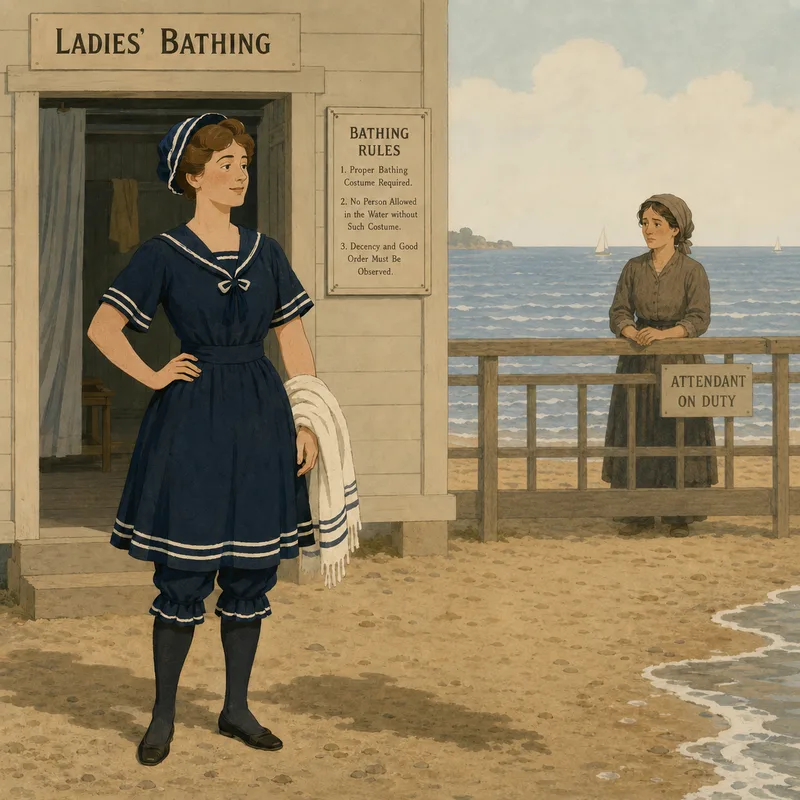
As public bathing became more regulated, bathing clothing became part of respectability.
And respectability has always been class-coded.
What the wealthy could buy, the poor could be judged for lacking.
This does not mean class was the only reason swimwear became common. It was not. Modesty rules, public bathing regulations, gender segregation, hygiene concerns, industrial textile production, changing leisure habits, fashion, and marketing all played a role.
But class matters.
A person who could afford the “proper” bathing garment could appear respectable. A person who could not could be seen as crude, indecent, backward, or low-class.
That pattern is familiar far beyond swimming.
Societies often turn access into virtue. First, a thing is expensive. Then it becomes respectable. Then it becomes expected. Then people who lack it are judged as if they have failed morally instead of economically.
Swimwear became part of that story.
At some point, the question shifted from:
“Do you want to swim?”
to:
“Are you properly dressed to be allowed near the water?”
That is a very different question.
The early swimsuit was not designed for freedom
A lot of early bathing clothing, especially for women, was not designed to help the body move freely through water.
It was designed to manage visibility.
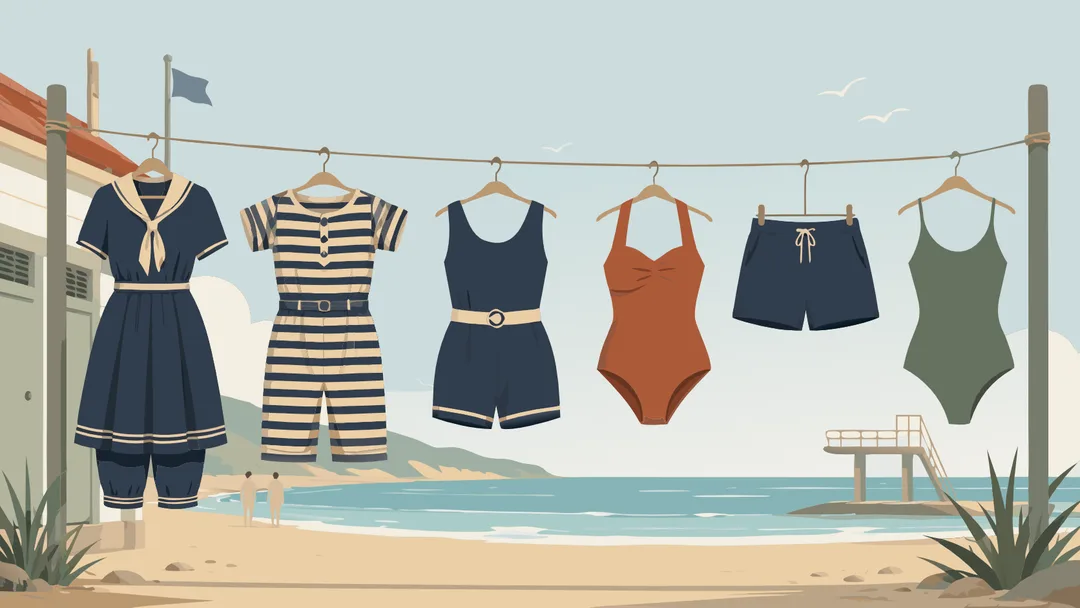
Long skirts. Heavy fabric. Covered limbs. Bathing gowns. Wool. Layers. Sometimes even weighted hems to keep the garment from rising in the water.
That is almost absurd when you think about it.
The thing supposedly making swimming acceptable could also make swimming harder, heavier, colder, and more dangerous.
This tells us something important: the first priority was not always swimming. Often, the first priority was controlling how the body appeared.
Women especially carried this burden. Their access to public water was shaped by modesty rules, surveillance, respectability, and male-defined standards of acceptable visibility.
Men often had more freedom. Women were more likely to be managed, covered, judged, and inspected.
That is not accidental. The history of swimwear is also a history of sexism and patriarchy.
It is a history of who was allowed to move freely, who had to be watched, and whose body was treated as a public problem.
Nude swimming did not disappear all at once
Nude swimming did not disappear all at once
Modern people often assume that nude swimming vanished long ago, as if swimsuits simply replaced it everywhere in one clean cultural shift.
That is not what happened.
In some places, nude swimming remained ordinary well into the modern era, especially in male-only settings such as schools, YMCAs, athletic facilities, and indoor pools.
In the United States, for example, boys and men sometimes swam nude in institutional pools well into the 20th century. This was not always framed as rebellion or “nudism.” In some settings, it was treated as practical, sanitary, or simply normal. Double standards for feel good swimming.

That history can feel surprising now because the cultural shift has been so complete.
In only a few generations, something once ordinary in certain settings became almost unthinkable.
That should make us pause.
Not because we need to recreate every past practice. We do not.
But because it shows how quickly “normal” can change.
Something can feel permanent simply because we were born after the change happened.
The swimsuit does not simply cover the body. It edits the body.
Today, swimsuits are treated as modest because they cover selected parts of the body.
But that selective covering is exactly what gives those parts extra charge.
Once the body is treated as something that must be selectively covered, the covered areas become loaded with meaning. The swimsuit does not remove sexual attention from the body. It often organizes it.
Nudity presents the body as a whole.
Swimwear divides the body into zones:
- acceptable,
- unacceptable,
- revealable,
- concealable,
- flattering,
- embarrassing.
That division is where much of the sexual charge begins.
This is not about blaming people who wear swimsuits. Most people wear them because that is the rule they were given. They are not trying to make a cultural statement every time they go to the pool.
And it is not about claiming that every swimsuit is designed with sexual intent. Many are practical. Many are ordinary. Many are worn for sun protection, sport, public access, comfort, modesty, fashion, habit, or simply because there is no socially permitted alternative.
But we should be honest about the cultural effect.
A swimsuit can cover the body while making the body feel more inspected.
It can conceal one area while drawing attention to another.
It can turn the body into a project: lift this, flatten that, hide this, show that, smooth this, shape that, improve this, apologize for that.
The question is not whether swimsuits are bad.
They are not.
The question is why a garment that often intensifies body inspection became the thing we call “modest.”
Coverage is not the same as comfort
Coverage is not the same as comfort
Swimsuits are supposed to solve the problem of nakedness.
For many people, they create a new problem.
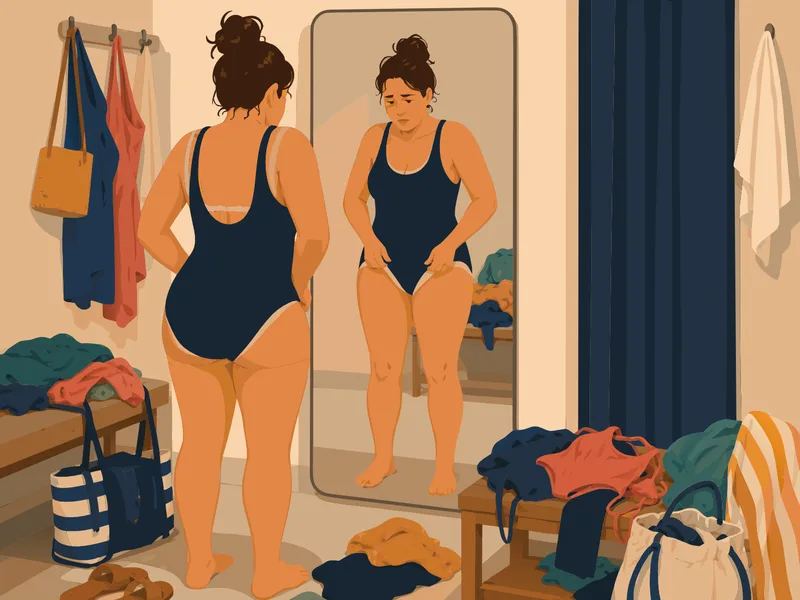
The body is no longer simply in the water. It is being compared, shaped, adjusted, tugged, covered, revealed, and evaluated.
This is why swimsuit anxiety is so common.
The swimsuit does not always quiet body shame. Sometimes it concentrates it.
It asks the body to pass through a narrow doorway before it is allowed to enjoy the water.
- Too big.
- Too thin.
- Too old.
- Too pale.
- Too wrinkled.
- Too hairy.
- Too exposed.
- Too covered.
- Too much.
- Not enough.
Ordinary nakedness, in the right context, can do something very different.
It can let the body become whole, plain, and human again.
- Not a performance.
- Not an advertisement.
- Not a before picture.
- Not a problem to solve.
- Just a body in water.
The swimsuit became the gatekeeper
The problem is not that swimsuits exist.
Many people like them. Many people need them. Many people enjoy the style, color, support, protection, or self-expression they provide.
That is fine.
The problem is not the swimsuit as an option.
The problem is the swimsuit as a gatekeeper.
The problem is that one cultural garment became the price of admission to one of life’s simplest pleasures.
A person should be able to enjoy water without having to enter swimsuit culture first.
That does not mean every place should be clothing-optional. Context matters. Consent matters. Privacy matters. Public norms matter.
Families, communities, hosts, and institutions all need clear expectations.
But it does mean we can question the assumption that the swimsuit is natural, neutral, or morally necessary.
It is not.
It is a garment with a history.
And like all garments with history, it carries more than fabric.
- It carries class rules.
- Gender rules.
- Body rules.
- Beauty rules.
- Respectability rules.
- Sexual rules.
- Shame rules.
Some people feel fine inside those rules.
Many do not.
A different way to think about swimming
A different way to think about swimming
It is not about turning swimming into an ideology.
Swimming is an “ing,” not an “ism.”
This is about noticing something simple:
Maybe the body was never the problem.
Maybe the problem is the cultural machinery wrapped around the body.

Maybe swimming could feel easier if we stopped treating the human body as something that must be corrected, packaged, disguised, and approved before it enters the water.
The past shows that our current assumptions are not permanent laws of human nature.
They are habits.
And habits can be questioned.
Swimsuits may remain useful, beautiful, practical, expressive, and welcome.
But they should not be treated as proof that the body underneath is indecent.
The human body is older than the swimsuit.
Swimming is older than the swimsuit.
Joy is older than the swimsuit.
And maybe, in the right setting, with the right people, under the right expectations,
one of life’s simplest pleasures can become simple again.